

Dr Tarunjit Singh Butalia
Introduction
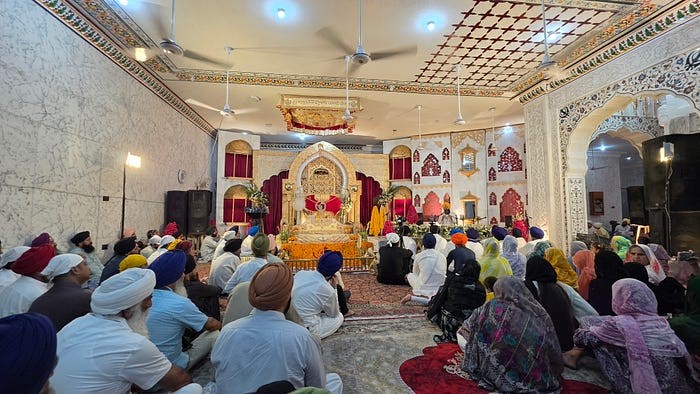
A jatha (group) of about 700 Sikh devotees from India crossed over a few days ago from the Attari-Wagah border crossing into Pakistan to commemorate the 420th martyrdom anniversary of Siri Guru Arjan Sahib, the fifth Guru, at Gurdwara Dera Sahib next to the Lahore Fort.
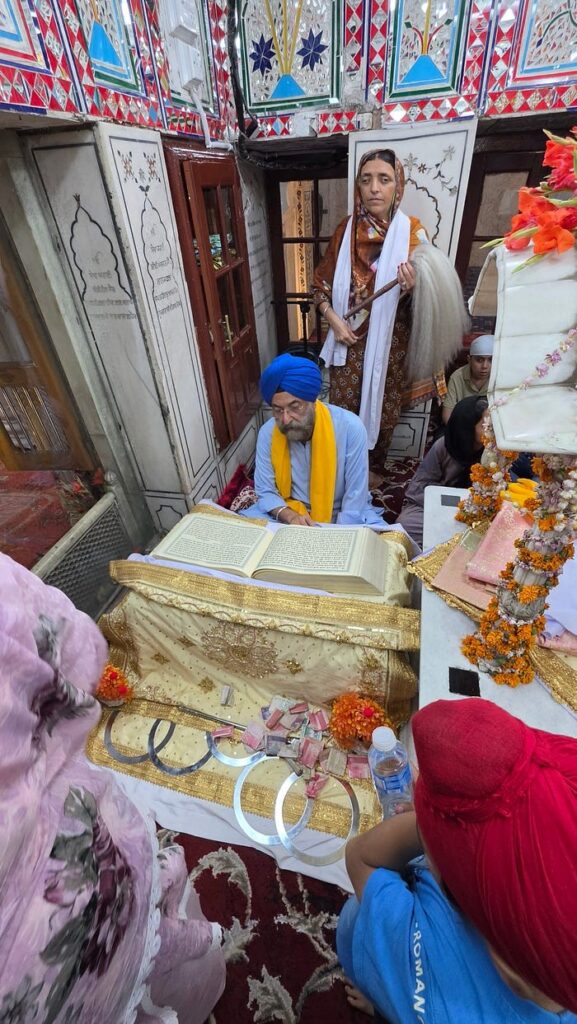
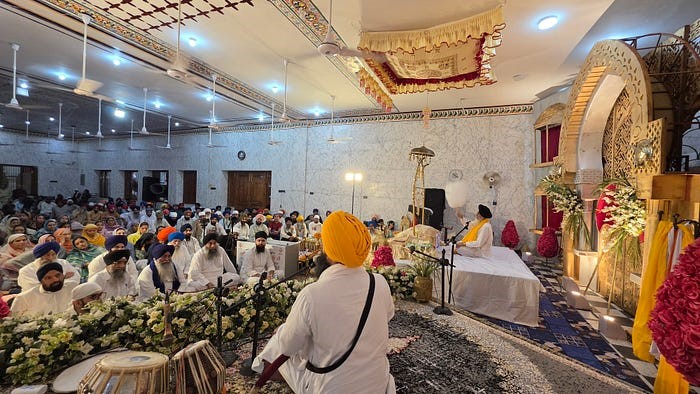
The observance concluded with an akhand paath (continuous reading) of Siri Guru Granth Sahib, whose initial compilation was carried out by the fifth Guru himself.
Guru Arjan was born in 1563 at Goindwal Sahib in now eastern Punjab. He was the younger son of Siri Guru Ram Das Sahib, the fourth Sikh Guru, who himself was born in Chuna Mandi in Lahore, now in western Punjab.
Guru Arjan, the fifth Sikh Guru, built Harmandar Sahib (now called the Golden Temple) in Amritsar from 1581 to 1589. Akbar visited Guru Arjan at Amritsar in 1598 and reduced taxes and the price of corn to provide relief to the people of Punjab. Later, Guru Arjan compiled the Adi Granth and installed it at Harmandar Sahib in September 1604.
Martyrdom of Guru Arjan
The tolerant Emperor Akbar’s death led to the rise of the intolerant Emperor Jahangir. Jahangir at the urging of deviant Sikh groups, especially Prithi Chand (the elder brother of Guru Arjan who was passed over for Guruship by his father) and others jealous of the rising influence of the Sikh community, arrested Guru Arjan and, after significant torture by Chandu Shah at Lal Khui (near Mochi Gate of Lahore), killed Guru Arjan near the Lahore fort on June 16, 1606. Some accounts state that he went into the Ravi River (which then flowed by the northern ramparts of the Lahore Fort) for a bath and never returned. Other accounts state that stones were tied to his body and he was thrown into the Ravi River.
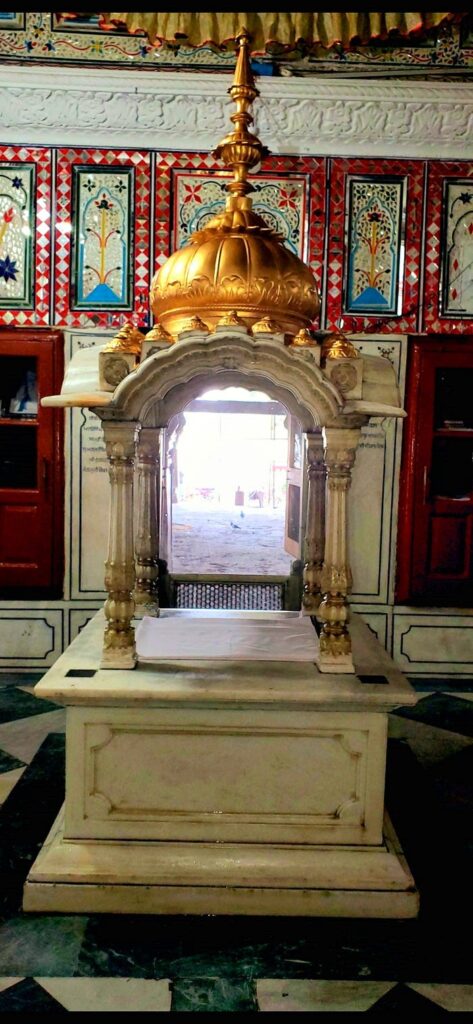
To commemorate the martyrdom of Guru Arjan, the sixth Guru built a Gurdwara here, which was later renovated by Maharaja Ranjit Singh in the early 1800s.
420th Anniversary Observances
On this 420th anniversary, an akhand paath was held in the small room where the fifth Guru was martyred. At the same time, Keertan (congregational singing) continued in the large hall recently built around the original small shrine.

Outside were throngs of Pakistani and Indian Sikh pilgrims mingling and drinking kachi lassi (sweet iced drink of water, milk, and sherbet). The event had a festive look but is, in fact, a somber gathering to commemorate, not celebrate, the martyrdom of Guru Arjan. Similarly, the crucifixion of Jesus and the martyrdom of Imam Hussain (the grandson of the Prophet Muhammad) are commemorated and not celebrated.
Reflections
The martyrdom of the fifth Guru led to the eventual militarization of the faith. Following the martyrdom of Guru Arjan, his son, Guru Hargobind, began wearing two swords, one representing Miri (worldly and political) and the other Piri (spiritual authority). He raised an army, built forts, and, in 1606, established the Akal Takhat (Immortal Throne) opposite Harmandar Sahib in Amritsar, and proclaimed himself the Sacha Patshah (True King).
Similar to his predecessors, Guru Arjan was primarily a religious and spiritual leader, but also a community leader and, eventually, a political actor.
The conflicts between Sikh Gurus and Mughal authority concerned justice, equality, and spiritual independence. It should be noted that regional governors and officials of the Mughal Empire often acted on their own, escalating conflicts, with or without directives from the central imperial authority. The local population of Punjab, on the other hand – Hindus, Muslims, and Sikhs – interacted in ways that weren’t always defined by the imperial policy of the Emperor.
For the Sikh community, the killings of Guru Arjan on the orders of Emperor Jahangir and carried out by Chandu Shah are a watershed moment of persecution. Some historians view this incident as persecution of the Sikh faith by Islam and Hinduism. Mughal Emperor Jahangir was a Muslim, but did not represent Islam. Similarly, Chandu Shah, a Hindu, did not represent Hinduism.
Placing the blame for the murder of Guru Arjan by Emperor Jahangir and Chandu Shah on Islam and Hinduism is misplaced. The real blame lies with Emperor Jahangir, Prithi Chand, who complained about the Guru to the Emperor, and Chandu Shah, who carried out the torture and murder of the fifth Guru.
The militarization of the Sikh faith following the martyrdom of Guru Arjan was reactive and protective, and not imperial in nature. The nature of the conflict between the Mughals and the Sikh Gurus was more political than religious. The battles of the Sikh Gurus were not against Islam or any other religion but resistance against tyranny, coercion, and injustice, irrespective of whether they were against Mughal authorities or their Hindu officials. To oppress is wrong, but to tolerate oppression is also wrong.
A common but misleading narrative is that Guru Nanak was a pacifist and that the Sikh tradition later shifted toward militarism after the martyrdom of the fifth Guru. This framing oversimplifies the historical and theological continuity of Sikh thought. From the first to the tenth Guru, there was no wavering on the core principles of freedom of conscience, equality of all human beings, and resistance to injustice. Guru Nanak himself confronted political oppression. His response to the invasion of Babur is enshrined in the Siri Guru Granth Sahib, where he condemns the violence and suffering inflicted upon the people of Punjab. This is not passive spirituality – it is moral and political resistance expressed through spiritual authority. Whether expressed through spiritual protest (Guru Nanak) or armed defense (later Gurus), the underlying principle remained the same: to stand against tyranny and injustice and to defend human dignity. What developed over time was not a change in values, but a change in methods, shaped by increasing political pressure and persecution – especially after the martyrdom of Guru Arjan. The later militarization under Guru Hargobind and Guru Gobind Singh should therefore be understood not as a departure from Guru Nanak’s teachings, but as their natural and necessary extension in a more hostile environment. A very common Sabad in the Siri Guru Granth Sahib is: “If you desire to play the game of love with me, then come to my street with your head in your hand.” This Sabad is commonly mistaken for Guru Gobind’s, but it is from Guru Nanak and is enshrined in the Siri Guru Granth Sahib.
The Sikh Gurus had political differences with some of the Mughal rulers, but they were never opposed to Islam. In fact, Islam, as a faith, is frequently honored and respected in Sikh history and quoted in the Siri Guru Granth Sahib. Hazrat Mian Mir, the Sufi Saint of Lahore, was a close personal friend of the fifth and the sixth Gurus. While the myth of Mian Mir laying the foundation stone of the Golden Temple is false, their friendship was deep – he advocated for Guru Arjan with Emperor Jahangir.
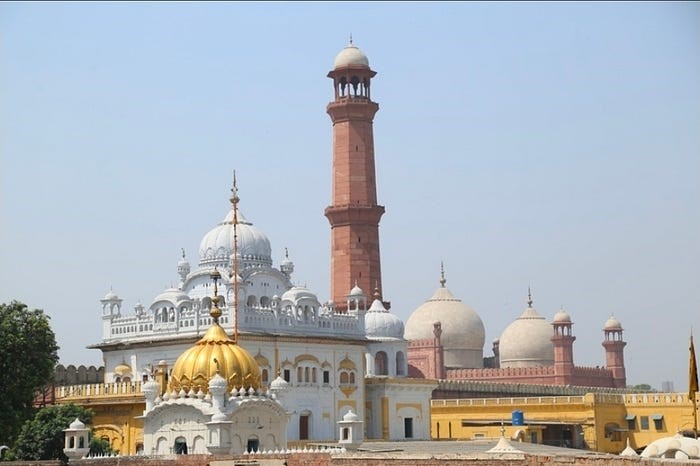
I observed that the large samadh of Maharaja Ranjit Singh dwarfs the small golden-domed shrine marking the martyrdom of Guru Arjan, both of which are adjacent to each other. Upon closer inspection, I noted that the Samadh was not built on a natural mound but rather on a large, high basement to elevate it. At the same time, the Gurdwara dedicated to the fifth Guru remained at a much lower level. A huge samadh was built for the Maharaj, which now dwarfs the Guru’s shrine. This is an indication of the wisdom of the descendants of Maharaja Ranjit Singh – no wonder the Sikh rule over Lahore and Punjab did not last more than a decade beyond the death of the Maharaja.
Closing Remarks
I had the privilege of participating in the akhand paath being held inside the small shrine marking the 420th anniversary of martyrdom of Guru Arjan. As I began to read from Siri Guru Granth Sahib, the following verse came on page 1071:
sulataan khaan kare khin keere
gareeb nivaaji kare prbhu meere
garab nivaaram sarab sadhaaran kichhu keemati kahee na jaaee he
(English translation:
Sultans and nobles are reduced to dust in an instant.
God cherishes the poor and makes them into rulers.
He is the destroyer of egotistical pride, the support of all. God’s value cannot be ascertained.)
Dr. Tarunjit Singh Butalia is a US based Sikh interfaith activist and scholar with deep roots in East and West Punjab in South Asia as well as the US.