

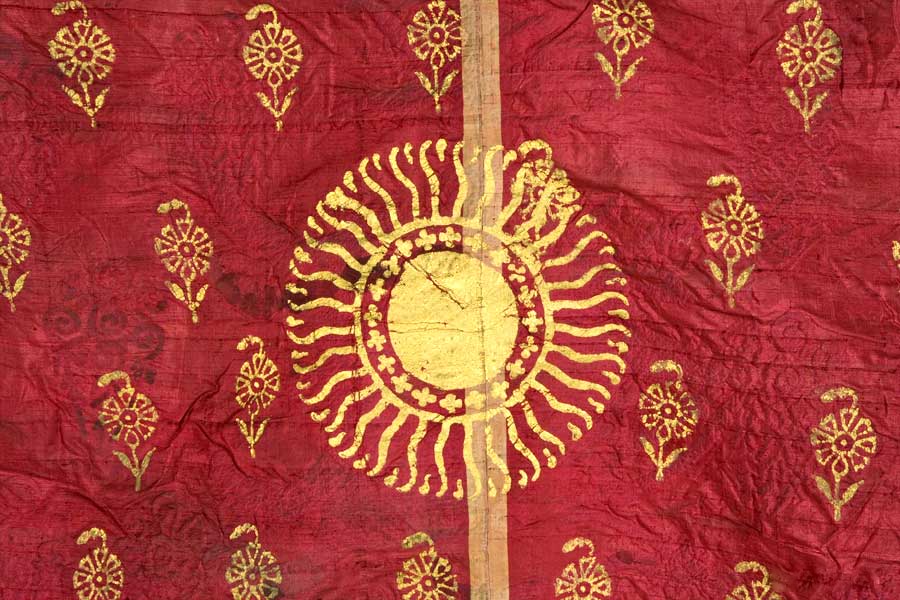
On 29 July 2024, the Akal Takht issued a hukamnama to change the colours of the Sikh flag, the Nishan Sahib to Basanti (Xanthic) or Navy Blue rather than then prevalent Saffron or Kesri. This sparked an online debate among the various schools of thoughts, of academics and religious organizations alike, and as you must have expected, the so-called online platforms claiming to represent the “original Sikh Culture”. Soon enough, photos of flags surfaced dating back to the times of the Second Anglo-Sikh War (1848-49), one of which had imagery of Hindu deities, and the other a red flag with a radiating sun. These webpages and online platforms went to the extent of labelling the “Devi Flag” as the original Nishan Sahib, which gave rise to a new conflict and debate:
What did the Nishan Sahib look like in the times of the Khalsa Raj?
Before arriving at a conclusion, it is important to remember that the very design and nature of the Nishan Sahib has historically varied, from plain banners during the Guru Period to embroidered with weapons during the Misl and Empire eras.
We have various sources at our disposal, the first one being an illuminated manuscript of the Guru Granth Sahib dating back to c. 1775 (Photo Courtesy: Sikh Museum)
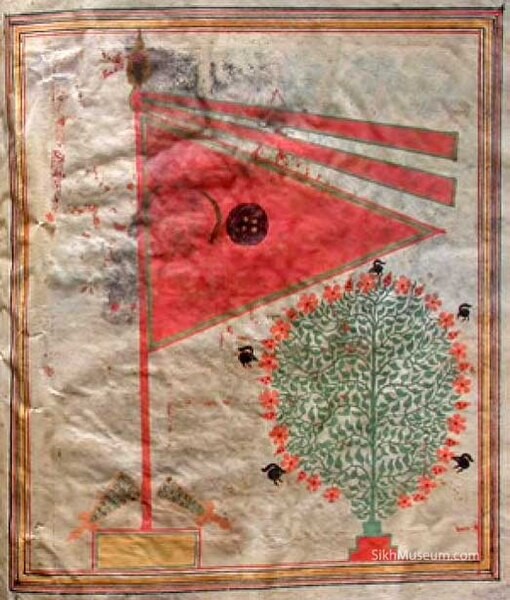
As you can observe the Nishan Sahib is Red in colour here (which gives another colour for the debate but that’s not our topic). You can see on the flag are embroidered a curved sword, which resembles a Persian Shamshir, and an Indian Shield Dhal.
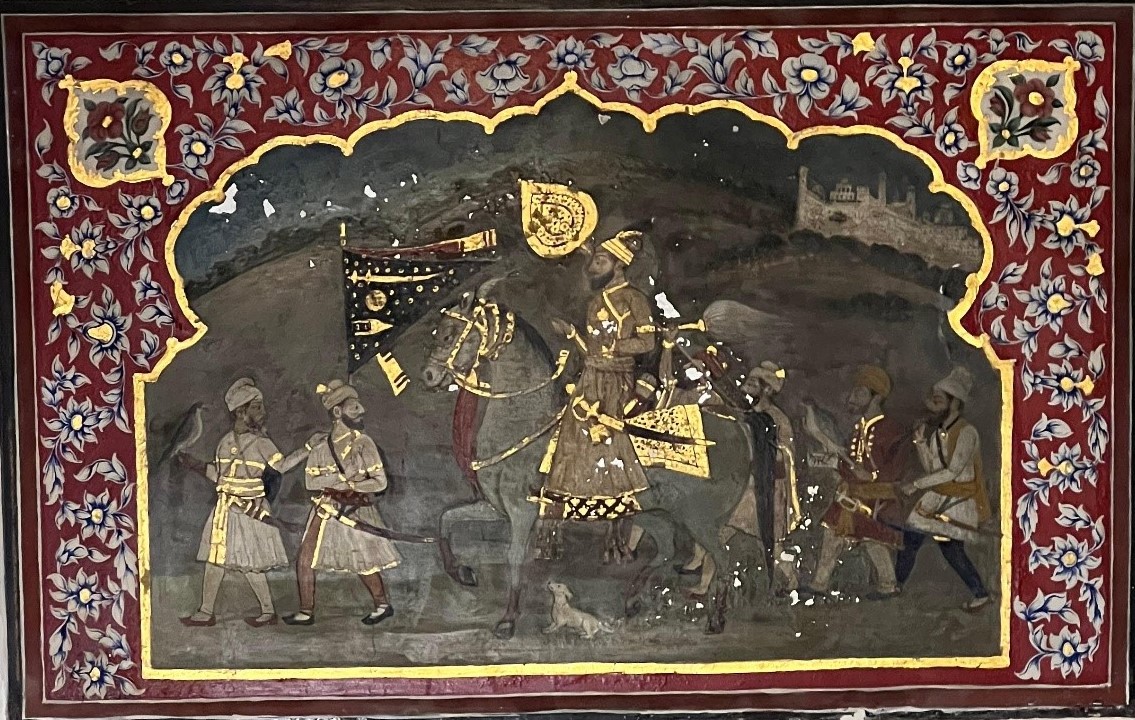
The Design of the Nishan Sahib changes as time progresses. As we move towards the Khalsa Raj era Nishan Sahib, we have this mural from the central Sikh Shrine, the Darbar Sahib at Amritsar. This mural is dated to the 1820s, and is located in the staircase at Darbar Sahib. It is painted in the Kangra style, representing Guru Gobind Singh with his Sikhs, bearing a Blue Nishan Sahib with Golden Floral prints and a talwaar, dhal and a katar in midst of the Navy Blue; and its shape too changes, almost looking like a Right-Angled Triangle.
These two flags are enough to discard the narratives that Nishan Sahib historically had Hindu deities on the “Nishan Sahib”, so does the “Devi” flag belong to the Khalsa Army?
The answer lies in how we often perceive the Khalsa Army, which was not composed only of Sikhs but had a good number of Muslims (Punjabi, Pashtun and Kashmiris and Baltis) and Hindus (Punjabi, Pahari and Dogras) and even Nepali Gurkhas as well as Europeans belonging to Christian and Jewish backgrounds in its ranks!
The regimental structure of the Khalsa Army was a hybrid, of standing regiments of Fauj-i-Ain (Regular Army) and Fauj-i-Khas (elite troops trained and led by the French Generals), and irregular regiments of Jagirdars which were often denoted by the term Dera (often for the Ghorchara troops). These Deras bore the name of the Sardars which commanded them, and these Generals too belonged to all the faiths–many deras have names like Dera Attariwala, Dera Sandhawalia, Dera Illahi Baksh, Dogra Dera etc.
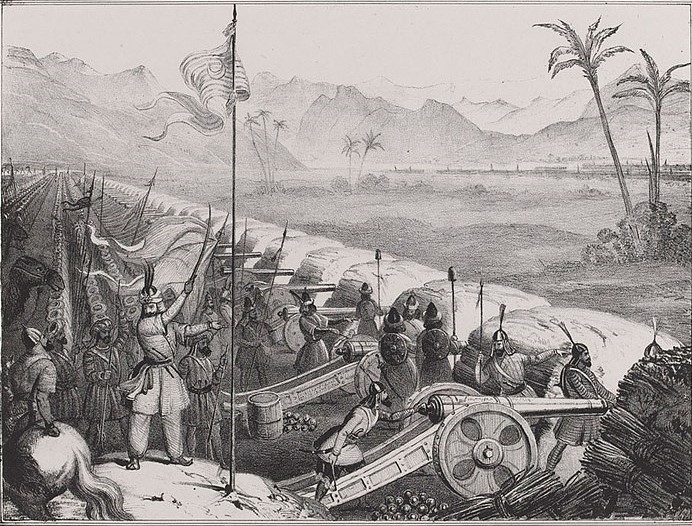
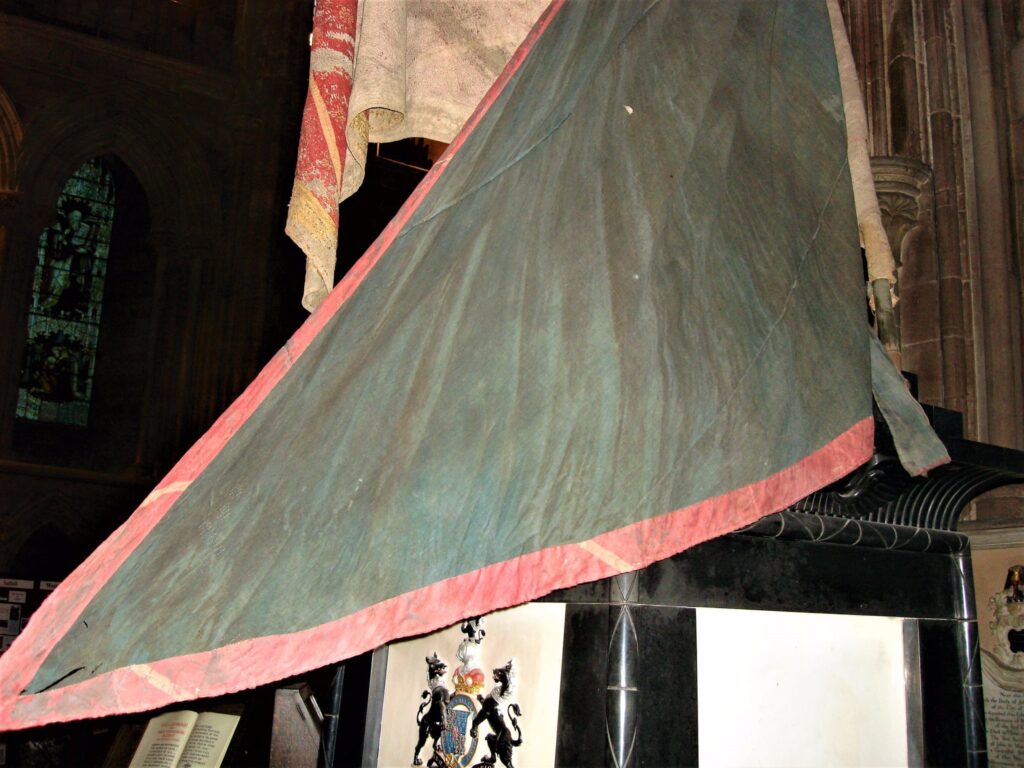
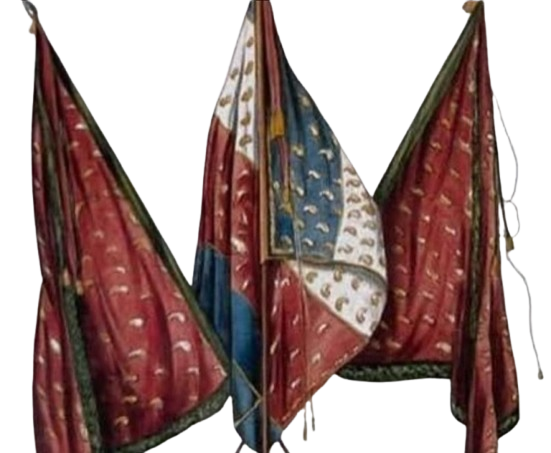
In the above scroll painting, depicting campaigns during the Sino-Sikh War of 1842, a fort flies flags that resemble other flags shown in the paintings of the Khalsa Raj. A blue flag with white variant is a new version also depicted here. Moreover, it’s a folly to say that the Nishan Sahib was the only flag that fluttered in the cantonments of the Khalsa Army, as there were also French Tricolors waving along the Khalsa Battle Standards – both local miniature and western oil paintings depict the French Flag, and one physical tricolour flag also survives!
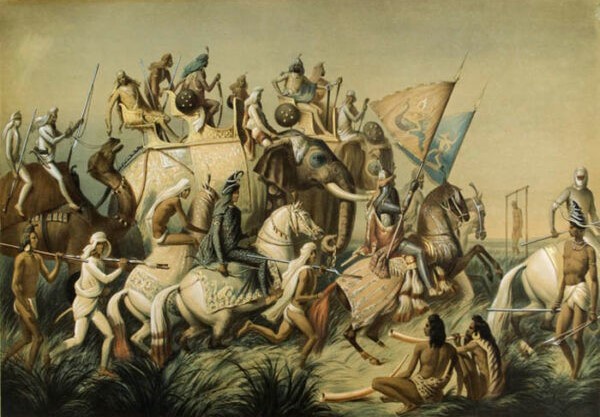
In the 1840s, when the Durbar was falling into political chaos, we observe one of the first Western depictions of the flags with Hindu Deities. Many lithographs based on the sketches by the Russian Aristocrat Alexey Saltykov, show female Hindu War Deities, especially belonging to the Shakti Tradition of Hinduism, the Seven Mothers Matrikas, the Kumari and Varahi, who are widely revered in the Himalayas of Himachal, Uttarakhand and Nepal.
So in early 19th century Punjab, and especially the Khalsa Army, which itself was a diverse composition, to have various flags, ranging from the Sikh Nishan Sahibs, to the Hindu Deities, French Tricolors, and Crescents was a common place occurrence. So the diversity of flags should not surprise us, and it does not make sense to bring 21st century identity-driven politics into the syncretic social life of the 19th century, where a Sikh/Hindu/Muslim soldier could be fighting under the flags of Hindu gods, the French Flag, the Nishan Sahib, or crescent without any fuss!
Now let us discuss the famous “Devi” flag that was captured on 21 February 1849 at the Battle of Gujrat during the Second Anglo-Sikh war. The Right Wing “Hindutva” online handles label it as Nishan Sahib, which is clearly wrong and a distortion of facts; many Panthic pages label it as a Dogra flag, ignoring the fact that Jammu and Kashmir had been separated since 1846 from the Sikh Empire and with it went the Dogra regiments. My opinion on how this flag came to fly in the predominantly Sikh forces, is based on the eyewitness accounts of the soldiers themselves who fought in the Second Anglo-Sikh War. In 1905, Karam Singh Historian interviewed many old people and war veterans of the Khalsa Army. Among them was Baba Jwala Singh of village Gajju Matah, Lahore district. While most of the Deras belonged to the Attariwala, Nalwa, Majithia and Mararia Sardars, there were two cavalry regiments, 2200 strong, with two Punjabi Hindu Generals as well, Ganpat Rai and Devi Sahai–under whom Baba Jwala Singh was stationed. Devi Sahai and his Dera were both present at the Chillianwala and Gujrat Battles, and it is not a mere coincidence to find a “Devi Flag” (the name of the General and the flag serves the same objective, Devi Sahai means ‘may the Devi protect you’).
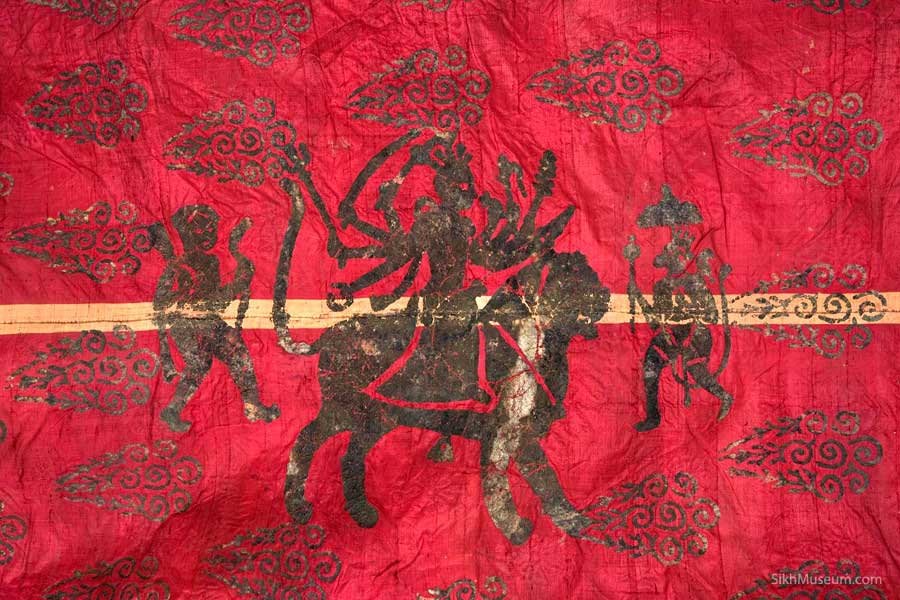
The flag depicting a Hindu Goddess on a tiger accompanied by Hanuman and Rudra-Shiva deserve a special mention here. I luckily came across the same three deities depicted on a 20th century Bazaar art poster at one of my friends’ home, who happens to be a devotee of Sheranwali Mata, or Vaishnoo Devi, of Katra!
Vaishnoo Devi Pilgrimage remains popular for Punjabi Hindus, and given that the Dogra Rajputs of Jammu were more Vaishnav inclined, it leaves us with this explanation that this flag most likely belonged to the Dera of Devi Sahai, especially given that there are other sources that speak to the presence and participation of Punjabi Hindus in the Khalsa army. For instance, Prakash Tandon in his autobiography, “The Punjabi Century”, mentions how Tandon’s family was based in Gujrat, and his great-grandfathers and their brothers used to provide supplies to the Khalsa Army and how one of his grandfathers also fought alongside the Sikhs at Chillianwala.
Finally, such political-agenda driven debates are enough to spread misinformation and to distort the understanding of the social and political life in times bygone. Such debates largely emerge from half-baked channels that should not be given any credence. They also represent what happens in a society where, as time passes, critical thinking and rational reading and tolerance is disappearing and paving way for hatemongers to further their agendas.
Punjab has a rich and diverse history, and so do Punjabis: Sikhs, Hindus and Muslims, all have played their role in the pre-colonial era, which has shaped our current realities.
Harmilan Singh runs the Instagram page Tawarikh-e-Punjab, writing about lost and forgotten episodes, artefacts and eras of Punjabi history. His goal is to bring the past to life through detailed storytelling and digital documentation. He also hosts heritage walks across Punjab. He can be contacted at harmilansingh12@gmail.com, or on Instagram: @tawarikh-e-Punjab.
References & Sources:
“A History of the Sikhs: From the Origin of the Nation to the Battles of the Sutlej” by Joseph Davy Cunnigham, 1849
- Jangnamah by Shah Mohammad
- S. Karam Singh Historian Di Itihasak Khoj
- The Last Sunset: Rise & Fall of Lahore Durbar, Captain Amrinder Singh
- The Rise of the Sikh Soldier, Dr. GS Mann
- Umdat ut Tawarikh by Sohan Lal Suri
- History of the Sikhs, Volume V, Hari Ram Gupta