

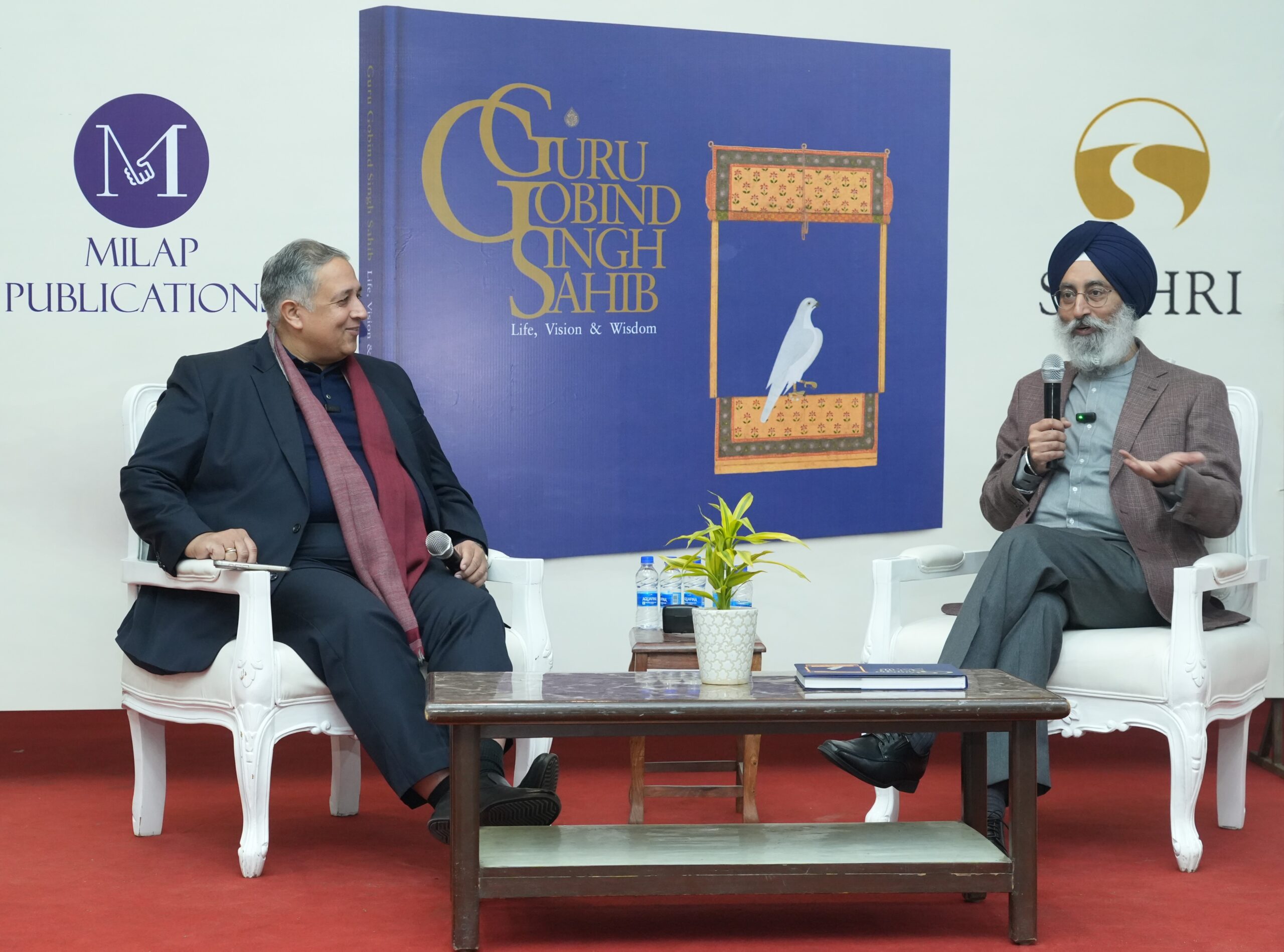
On 7 January 2026, in New Delhi, thinker, author, and educator Harinder Singh, co-founder of the Sikh Research Institute, joined publisher Yogi Suri of Milap Publications for a public conversation on Guru Gobind Singh Sahib: Life, Vision & Wisdom. The event marked 350 years since Guru Gobind Singh Sahib’s Gurgaddi, his coronation as the Tenth Sovereign, and created space to reflect on devotion, justice, and sovereignty in contemporary life.
Suri opened by situating the book not merely as a research undertaking, but as an offering. Some books, he observed, are written primarily with the mind; some with the heart; and some are written at the feet of the Guru. This volume, he suggested, belongs to the third category. It is not designed for quick consumption, but invites attentive engagement.
If the book’s heart could be named as a feeling, what would it be?
Harinder began with music rather than history. The book is anchored in ten Sabads (popularly Shabads), nine of which are set in Rag. In the Indian (Hindustani and Carnatic) classical music traditions, rag is inseparable from ras, the emotional sentiment that shapes the experience of sound. Form and feeling are not separate. The sentiment he sought to evoke is awe.
He described how his own relationship with Guru Gobind Singh Sahib evolved. In childhood memory, the Guru appeared as a heroic and expansive presence. Later, that image matured into a model of conduct and leadership. Over time, the figure became the Guru in a deeper sense, representing wisdom itself and serving as illumination in an era that often feels fractured.
The book’s structure attempts to mirror that progression. Through Sabad, commentary, and reflection, it encourages readers to move from admiration toward encounter. In explaining this movement, Harinder turned to the word sangat. He described it as coming together with purpose rather than simple assembly. True gathering, in this sense, implies shared orientation. The book aims to create that orientation through sound, word, and context.
He also referred to Hajare (erroneously Hazare), which he read through hijr, or separation. Modern life is marked by fragmentation, whether spiritual or political, and interior or exterior. The book speaks to that condition by attempting to reduce the distance between the reader and the source. Awe, as he framed it, is not passive reverence. It is the beginning of a relationship.

What compelled you to undertake such an extensive research project?
Harinder identified reduction as the central concern. In public discourse, Guru Gobind Singh Sahib is frequently compressed into simplified characterizations shaped by contemporary politics or ideological convenience. In a culture that privileges speed and summary, complexity is often flattened.
The concern, he explained, is not disagreement but over-simplification. Who is explaining the Guru, and from what lens? In response to what he described as a battle of narratives, his approach was methodological rather than argumentative. He chose to return to primary compositions and to early witnesses who lived within the Guru’s presence.
The book draws on Sabads attributed to Guru Gobind Singh Sahib, as well as on the Guru’s court-poets, Bhai Nand Lal Goya and Chandra Sain Sainapati, whose writings provide proximity rather than retrospective interpretation. Rather than attempt an exhaustive chronological biography, he selected ten Sabads as focused entry points.
Within Sikh tradition, Sabad is central. It is not merely written text but a revelation transmitted through word and sound. When early tradition asks Guru Nanak Sahib, “Who is your Guru?” the answer given is Sabad.

Why structure the book non-chronologically?
The question arises naturally because modern biography typically follows a sequence. Harinder challenged the assumption that sequence alone provides understanding.
Across the 238 years of the Gurus’ lived presence in ten embodiments, early Sikh sources did not commission or prioritize linear biography in the modern sense. The emphasis lay on principles and domain rather than on trivial matters like dates.
The structure of the book reflects this distinction. By organizing the material around Sabad and thematic inquiry rather than timeline, the work aligns itself more closely with the internal logic of early sources.
He referenced Bhai Nand Lal’s Ganjnama, in which Guru Gobind Singh Sahib is described as Saltanat-i-Daham, the Tenth Sultanate. The emphasis is on the Guru’s grandeur and on the embodied domain. Similarly, Chandra Sain Sainapati’s Sri Gur Sobha presents episodes that illuminate character and decision-making in volatile circumstances, including negotiations, betrayals, and shifting allegiances.
Life, Harinder noted, is rarely experienced as an orderly sequence. It unfolds amid instability and moral complexity. The deeper question, therefore, concerns how one remains anchored when conditions shift. The book seeks to engage that question through evergreen thematic exploration rather than ever-contested chronological reconstruction.
Why is your name not on the cover?
Before posing the question, Suri reflected on the book’s form. He described it as resisting easy categorization. It is not simply a coffee table volume, though it is visually striking. Nor is it solely an academic study, though it is rigorously sourced. The research and visual language function in dialogue. The artwork creates intervals that allow reflection rather than decoration.
Harinder responded directly to the authorship question. The work, he said, is not his. The inside pages carry the Guru’s signature. His role is interpretive, rendering insights from primary and early secondary sources into language accessible to contemporary readers.
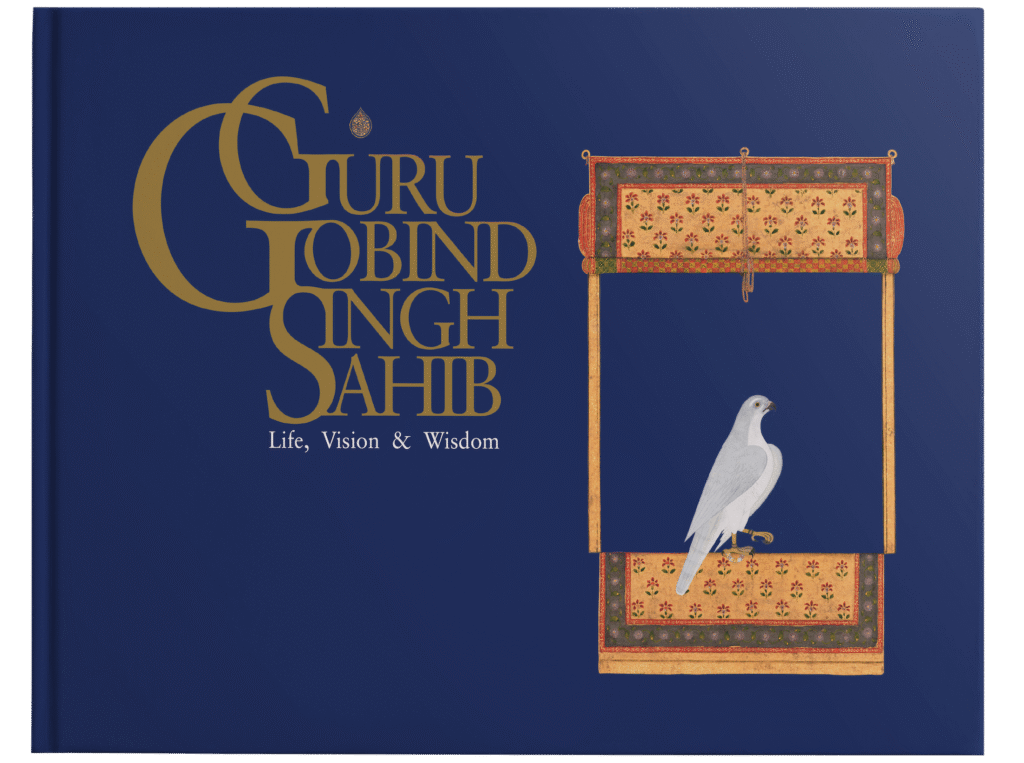
The project was collaborative. Kiran Kaur created the ten paintings that accompany the selected Sabads, while the book’s broader design and visual architecture were developed by Praveen Kumar. From the outset, the visual direction emphasized restraint, including the decision not to include a portrait of the Guru.
Instead, presence is conveyed through atmosphere. Deep blues suggest introspection, muted gold signals illumination, and expanses of space create a visual pause. Recurring motifs such as the hawk, the blue steed, the unfolding numeral “੧” of Gurmukhi script, and the Sabads rendered in gold function symbolically rather than illustratively. A subtle circular mark following commentary sections signals interpretive humility.
In Sikh thought, the deeper concern is not physical likeness but the mind’s projections. By declining portraiture, the book encourages engagement without reducing the Guru to an image.
How did you approach translation?
Harinder expressed hesitation about the word translation itself. Tightly structured compositions embedded in devotional and linguistic traditions cannot be transferred without interpretive choice. Every translation carries emphasis and omission. For that reason, he explains why he included commentary alongside a tight translation that carries both the letter and spirit of the original text, rather than a definitive translation.
His approach is transparent. The commentary reflects what Guru Gobind Singh Sahib’s Sabad conveys to him at this stage of his life. If it resonates with readers, the space becomes shared. If it does not, the limitation rests with the interpreter rather than with the source. This stance reflects both methodological clarity and devotional humility.
What does the book convey about justice and sovereignty today?
The word sovereignty often evokes political authority. Harinder reframed it. In the Sikh vision he articulated, sovereignty begins with interior freedom. Before it manifests in governance, it must be realized within the individual as azad, free. Without self-sovereignty, outward claims to freedom lack substance.
He referred to early accounts describing how Banda Singh Bahadur was accompanied by five Sikhs characterized as azad, for they were independent and sovereign in conviction. Freedom was not rhetorical. It required individuals already inwardly anchored.
In this framework, sovereignty is not dominance but steadiness in the Guru’s sovereignty. Justice is not vengeance but disciplined pursuit, especially in defense of dignity or protection of honor.
He also noted the instability of regional alliances during the Guru’s time. Allegiances shifted frequently according to convenience or expedience. Against this volatility, the Guru’s position remained consistent. Sovereignty, in this sense, is principled rather than opportunistic.
Underlying the discussion of justice and sovereignty is devotional love, described not as sentiment but as orientation. Devotional love remains patient even in longing. It does not collapse into self-concern during a crisis.
In moments of profound loss and separation, the voice of the Sabad remains directed toward responsibility and relationship rather than self-pity. Sovereignty without love risks becoming control. Love without discipline risks becoming sentimentality. Held together, they form moral and ethical clarity rooted in devotion.
A Book for an Anniversary and an Era
Published in commemoration of 350 years since Guru Gobind Singh Sahib’s coronation as the Tenth Sovereign, Life, Vision & Wisdom does not attempt to produce a definitive biography. Instead, it offers ten Sabads as portals, early historical witnesses as grounding context, and a carefully constructed visual language that creates space for reflection.
The conversation in New Delhi made clear that sovereignty, as articulated in the book, is neither a slogan nor a spectacle. It is first cultivated internally and then expressed outwardly through disciplined action. It demands steadiness rather than reaction, clarity rather than volume.
Rather than fixing Guru Gobind Singh Sahib within a single historical frame, the book asks a more pressing question: what does sovereignty require of us now? In that sense, the anniversary is not only commemorative. It becomes contemporary.
Video Link: https://www.youtube.com/watch?v=d1v8EbvbBnk